Judicial Tools: rebuilding a courtroom workspace under real legal pressure.
I led the end-to-end redesign of the digital workbench immigration judges use to adjudicate removal proceedings, building the agency's design process from scratch and turning a fragmented legacy workflow into a fast, reliable litigation workspace. Service desk complaints dropped 76% after launch.

Impact
• Cut post-deployment support tickets and service desk complaints by 76% across the judicial network. • Took the org from zero design process to an institutionalized Agile UX practice adopted across all 15 product lines. • Built a Severity Framework that turned qualitative research into prioritized technical requirements and directly shaped the quarterly roadmap. • Fixed the order-generation workflow, where 86% of judges had previously hit hard blockers.
Deliverables
One of two product designers inside a 105-person technical org (90+ engineers, 15 PMs), supporting hundreds of active immigration courts nationwide.
Year
2022
Role
Lead Product Designer (Founding member of the design practice)
Context: rebuilding a courtroom workspace under real legal pressure
EOIR, an agency under the Department of Justice, runs on tight legal timelines and heavy backlogs. When an outside consultancy shipped a baseline application with almost no user validation, courtrooms felt it immediately: high cognitive load, no data safeguards, none of the day-to-day realities of a courtroom accounted for. I came in as one of the first two product designers in a 90-engineer org, tasked with building design practice from the ground up and shipping a workspace that actually worked for judges.

Research system: turning judge pain points into ranked requirements
I combined the Double Diamond framework with Lean UX, built into two-week Agile sprints, around four pillars: Discovery (field interviews and system audits), Definition (severity indexing and epic-writing), Ideation (co-design workshops and wireframing), and Implementation (design QA and engineering sign-off).

Core breakdown: where legal order generation failed
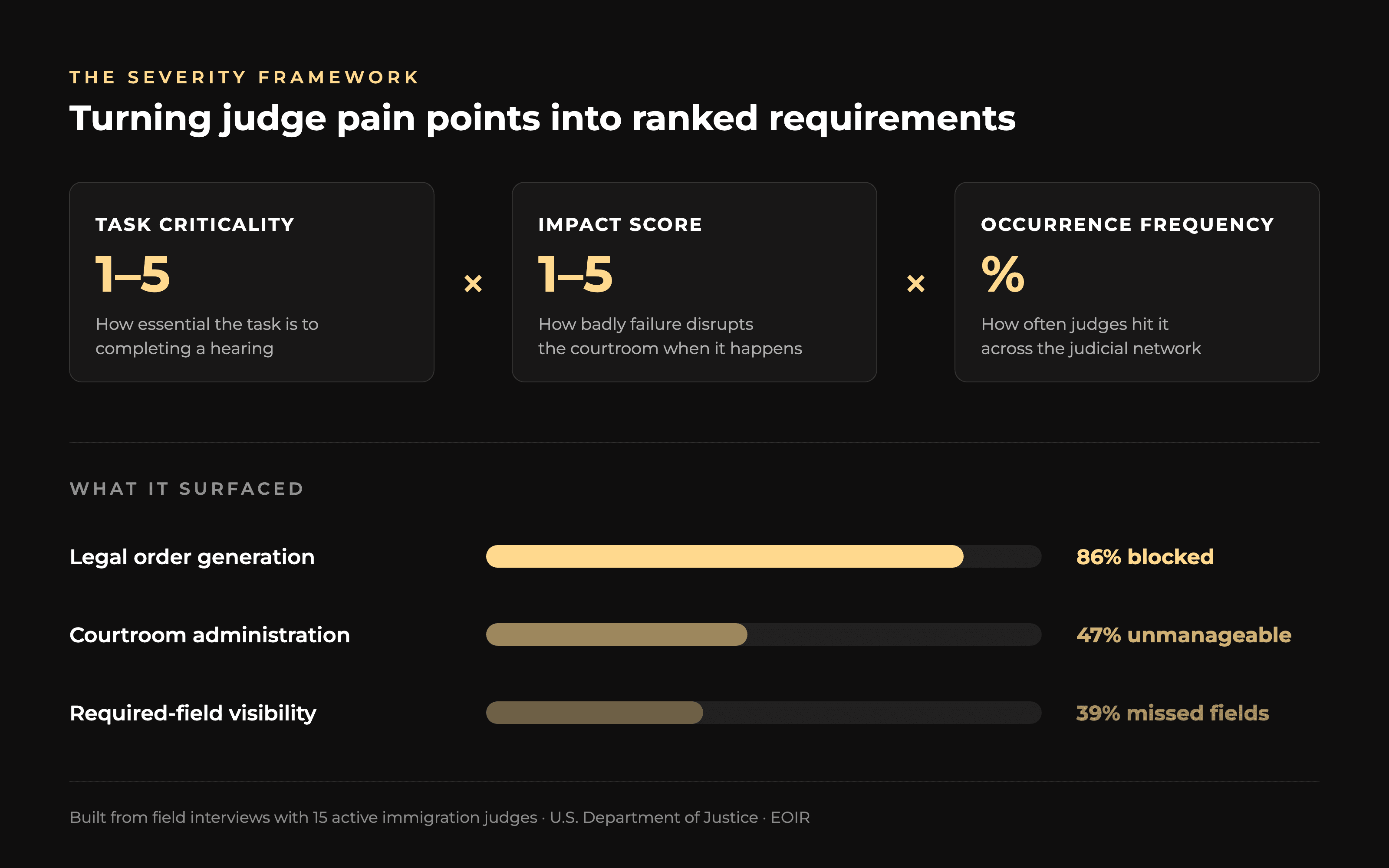
The existing app had no usability benchmarks, and hearings were bottlenecked as a result. To make the case to a highly technical team, I needed data, not opinions, so I interviewed 15 active immigration judges and built a Severity Framework: Severity = Task Criticality (1–5) × Impact Score (1–5) × Occurrence Frequency (%) That pointed straight to the biggest problem: document generation, e-signatures, and legal submission. 86% of judges hit a blocker generating legal orders, 47% called courtroom admin unmanageable, and 39% missed required fields because the form had no visual hierarchy at all.
Design direction: safer flows for dense judicial decisions
I designed around four fixes: compressing scattered document states into one clear progressive flow; locking submission until every legal condition was met; grouping dense form fields to match how judges already think about case structure; and building one reusable pattern for every e-signature moment going forward.

Outcome: a scannable workstation judges could trust
I shipped a scannable workstation layout in Adobe XD that broke complex legal tasks into clear sub-steps, using grouping and proactive alerts to stop field omissions before they happened. I also set up a formal Design QA gate in the sprint cycle: every front-end ticket got a UX review before deployment, so what shipped matched what was designed.


Takeaways
In a room with 90 engineers and 2 designers, data wins arguments that opinions can't; the Severity Framework did more to move decisions than any mockup. Scaling a design practice from nothing means building the infrastructure early: shared assets, QA loops, the boring stuff that holds up later. And staying close to engineering during early wireframing caught constraints before they became rework.