Respondent Access
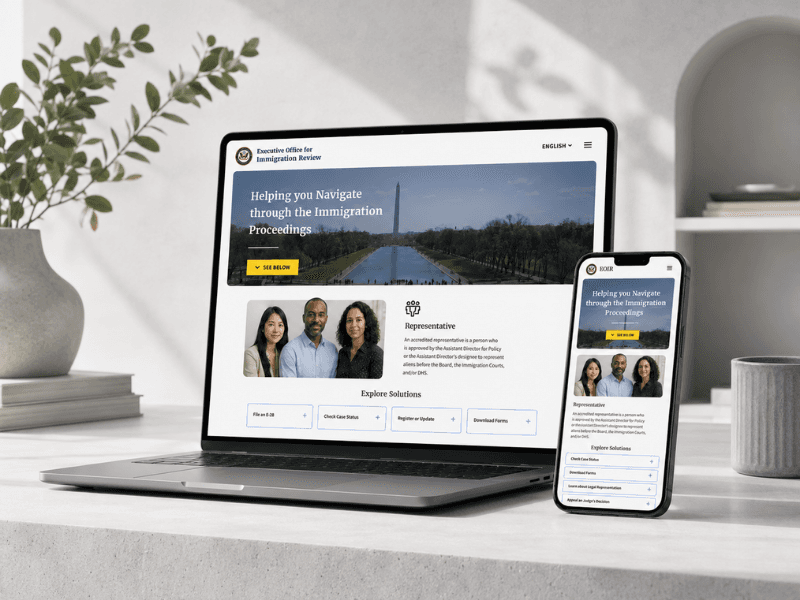
I designed a centralized, 508-compliant portal that consolidates DOJ immigration court and Board of Immigration Appeals resources — giving attorneys, respondents, and the public one place to navigate complex proceedings instead of a dozen disconnected tools.
Impact
• Drove a 34% increase in platform adoption. • Reached an 8/10 user satisfaction score in usability testing. • Turned a multi-step, disconnected document process into one cohesive workflow.
Deliverables
National DOJ-EOIR platform serving thousands of daily users — attorneys, respondents, and the public — across very different needs and levels of legal familiarity.
Year
2019
Role
Lead Product Designer (UX/UI, User Research, Strategy, Prototyping)
Context — one public portal for a fragmented legal journey
DOJ-EOIR ran on fragmented, single-purpose tools and manual offline processes for case management. The goal was one unified, single-source-of-truth application that made immigration resources genuinely accessible, for people navigating an already difficult system.

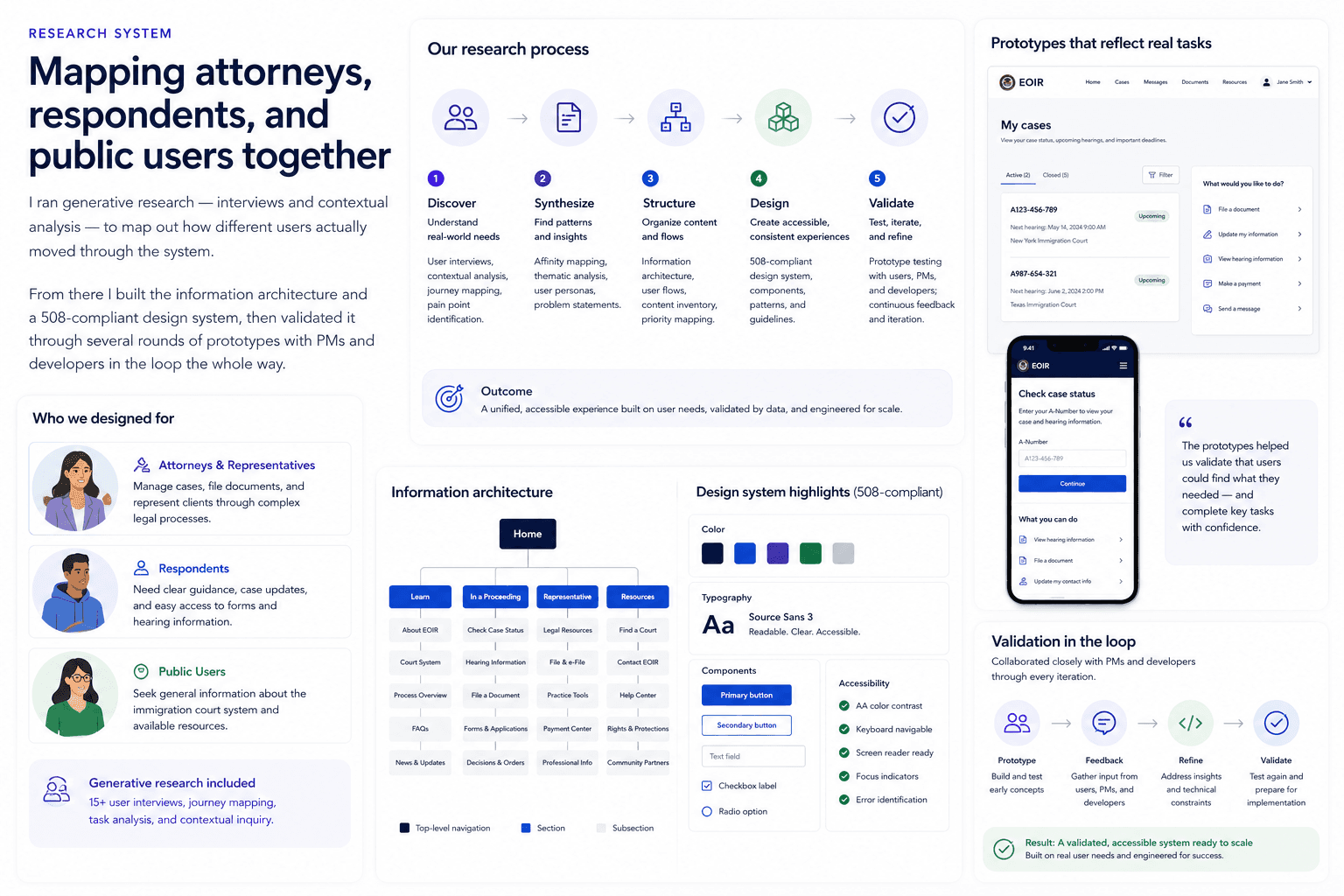
Research system — mapping attorneys, respondents, and public users together
I ran generative research — interviews and contextual analysis — to map out how different users actually moved through the system. From there I built the information architecture and a 508-compliant design system, then validated it through several rounds of prototypes with PMs and developers in the loop the whole way.
Core breakdown — disconnected tools created avoidable uncertainty
Users were piecing together their case across disconnected, single-purpose tools — real friction, real cognitive overload, and no visibility into where things stood. Research showed that disconnectedness, more than any single missing feature, was what was killing productivity and blocking communication during case development.

Design direction — fewer steps, clearer status, accessible submissions
I pushed for one unified, omni-channel platform built around three ideas: cut the number of steps wherever possible, add proactive validation to forms so errors surface early, and standardize a UI pattern library for secure document submission.

Outcome — a 508-compliant portal that made the system navigable
I shipped a fully responsive, 508-compliant portal that replaced the old patchwork of tools with one streamlined journey — a modern component library, unified dashboards, and task flows that walk people through dense legal processes with actual confidence instead of confusion.

Consolidation is a UX problem before it's a technical one — the biggest wins here came from removing steps and tools, not adding features. And when your users range from first-time respondents to career attorneys, clarity has to work for the least experienced person in the room without slowing down the most experienced one.
